
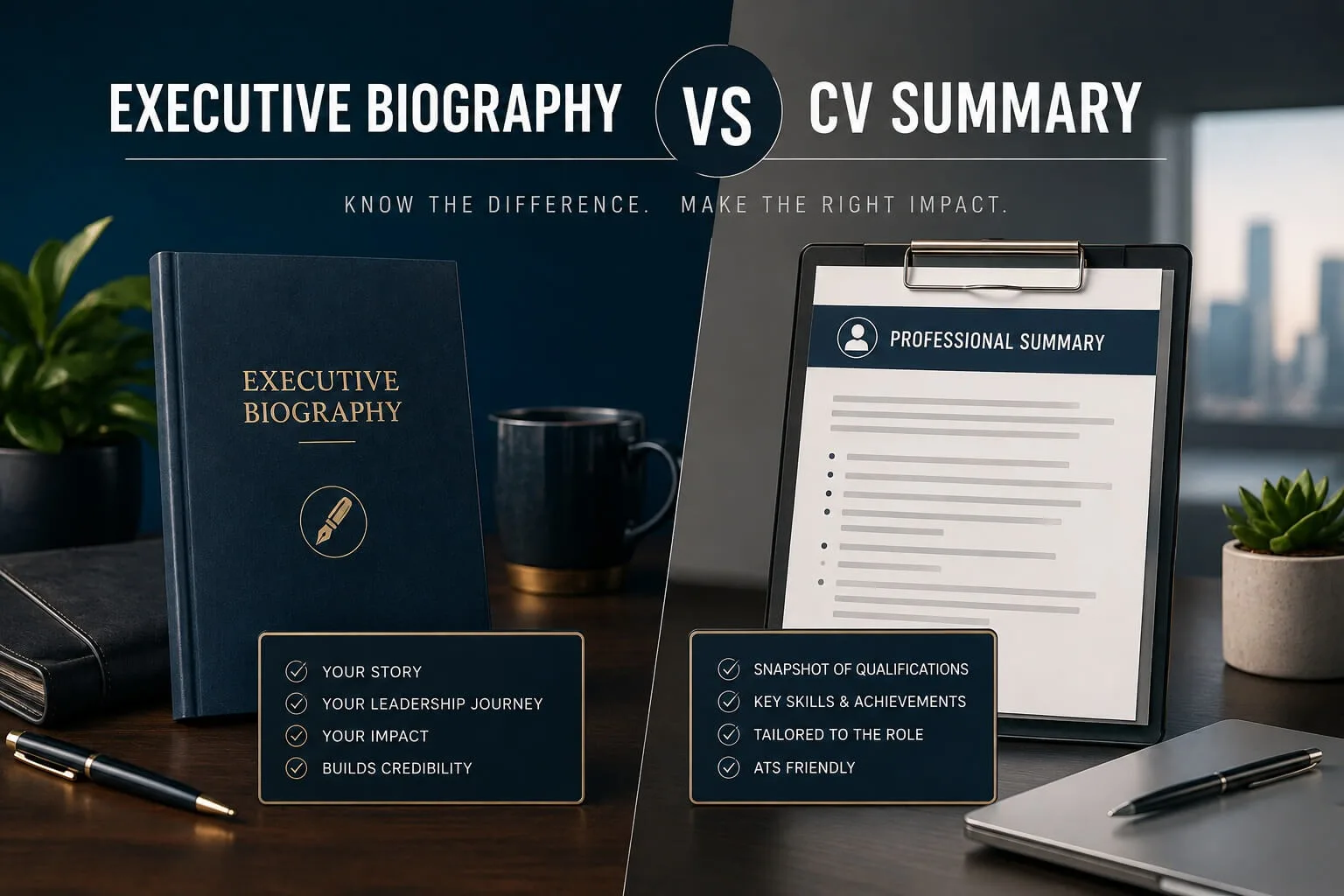
An executive biography and a CV professional summary are not two versions of the same paragraph. They have different authors, different readers, and in a large part of a senior leader’s working life, different legal status. The CV summary is written by the executive, for an intermediary deciding whether to advance them. The executive biography is, in its original home, written by the organisation about the executive, for a third party: a shareholder voting on an election, a delegate reading a programme, a nomination committee assessing a slate. Almost everything that separates the two documents follows from that single difference.
That difference is not a matter of taste. In South Africa, the United Kingdom and the United States, a director’s biography is a mandated disclosure with a specified content list, a defined trigger and, in one case, a five business day deadline. The JSE requires a brief CV in the notice of every annual general meeting at which a director stands for election or re-election. King V recommends a brief professional profile including that person’s existing professional commitments. The Financial Conduct Authority requires a five-year record of other quoted directorships, unspent convictions and disqualifications within five business days of an appointment. The US Securities and Exchange Commission requires five years of business experience, 10 years of legal proceedings, and an explicit argument for why this particular person should serve.
This guide sets out where the biography is compulsory and where it is convention, what the regulated versions must contain, what the third-person convention actually rests on, what can honestly be said about length, and how the two documents differ when the same career is written into each. Every rule below is cited to its instrument and its paragraph number, and every one of them is current as at the date of review.
Last reviewed 8 August 2026.
Executive biography vs CV summary: the difference in one table
| Executive biography | CV professional summary | |
|---|---|---|
| Who writes it | The organisation, about the executive, in its regulated destinations | The executive, about themselves |
| Who reads it | Shareholders, regulators, delegates, journalists, nomination committees | A search consultant, a screening system, a hiring executive |
| What decision it supports | Whether to elect, appoint, invite or quote you | Whether to advance you to the next stage |
| Person | Third person, for a structural reason set out below | Implied subject: statements begin with verbs, not pronouns |
| What it foregrounds | Capacity, mandate, tenure, other positions held, standing | Scale, sector, the decisions taken and what they produced |
| Personal dimension | Present in unregulated destinations, and in South Africa the regulated version carries age | Omitted, and search-firm guidance advises omitting age |
| Length | Set by the destination. Four separate provisions say “brief” and none quantifies it | Set by the document. No evidenced standard exists |
| Screening software | Does not encounter it. An AGM notice and a proxy statement are not parsed by an applicant tracking system | Written knowing a machine reads it first |
The last row is the one that most often gets misused. A biography does not need to survive keyword screening, because none of its destinations screen. That is a reason to write it differently, not a reason to write it loosely.
Is an executive biography a legal requirement?
For a director of a listed company, in the three markets examined here, yes. The obligation sits on the company rather than on the individual, which is precisely why so few executives know it exists. Below is every destination we could establish, marked rule or convention.
| Destination | Market | Status | Instrument | What it specifies |
|---|---|---|---|---|
| Notice of AGM, director election and re-election | South Africa | Rule | JSE Listings Requirements 5.4 | “A brief CV and capacity of each director standing for election or re-election” |
| Notice of AGM, candidate profile | South Africa | Recommended practice. JSE 5.1 makes mandatory those King Code practices the Requirements themselves incorporate | King V Recommended Practice 37(d) | A brief professional profile of each candidate, including details of existing professional commitments |
| Pre-listing statement | South Africa, main board and AltX | Rule | JSE 5.7(b), applied to AltX by 5.8(b) | A brief CV and capacity of each director |
| Integrated report board profile | South Africa | Recommended practice, itemised | King V Disclosure Framework, Principle 5 | Qualifications and experience, period of service, age, other governing body and professional positions held |
| Prospectus registration document | United Kingdom | Rule | FCA PRM App 2 Annex 1, Item 12.1 | Relevant management expertise and experience, plus at least five years of convictions, bankruptcies and sanctions, and whether the person has ever been disqualified |
| Director appointment announcement | United Kingdom | Rule, within five business days | UKLR 6.4.6R and 6.4.8R | Name and capacity; all other quoted directorships over five years; unspent indictable convictions; insolvencies; public criticism by authorities and any disqualification |
| Papers accompanying election resolutions | United Kingdom | Comply or explain | UK Corporate Governance Code 2024, Provision 18 | The specific reasons why this director’s contribution is important to long-term sustainable success |
| Annual report leadership pages | United Kingdom | Convention. No requirement | DTR 7.2 requires no director biographies | Nothing. The page is published because everyone publishes it |
| Proxy statement for a director election | United States | Rule | Regulation S-K Item 401, required by Schedule 14A Item 7 | Names and ages; five years of business experience; why this person should serve; other registered directorships over five years; 10 years of specified legal proceedings |
| Conference programmes, press releases, media kits, award entries, unlisted company leadership pages | All | Convention | None located | Whatever the destination’s own form asks for, and nothing more |
South Africa: the biography is a listing rule
The JSE rewrote its Listings Requirements under the Simplification Project. The rewritten requirements came into force for new applicants on 13 January 2026 and for existing issuers on 16 February 2026, so anything written against the older, longer version now describes a superseded document.
Paragraph 5.4 is the operative sentence: “A brief CV and capacity of each director standing for election or re-election must be included in the notice of annual general meeting.” Capacity is defined at 5.2 as executive, non-executive or independent non-executive. Paragraph 5.7(b) applies the same requirement to the pre-listing statement, and 5.8(b) extends it to AltX issuers, so this is not a Top 40 concern.
Note the trigger. Paragraph 5.5 requires a third of all non-executive directors to retire at each annual general meeting, and 5.4 covers election and re-election. A sitting director’s biography is therefore republished on roughly a three-year cycle whether or not anything about them has changed. Most directors think of the biography as something written once on appointment. It is not.
King V then adds the content, on an apply and explain basis rather than as a hard rule. Recommended Practice 37(d) provides that “a brief professional profile of each candidate standing for election at the AGM, including details of existing professional commitments, accompanies the notice of the AGM”. That single sentence names the artefact as a professional profile rather than a CV, names the destination, and specifies a content element that no CV would normally foreground. Note that JSE 5.4 does not carry that element across: the listing rule asks for a brief CV and capacity, and the existing commitments come from the code. The King V Disclosure Framework goes further and itemises what a board profile should disclose: the qualifications and experience of each member, each member’s period of service, the age of each member, and the other governing body and professional positions each member holds.
King V, not King IV. The JSE defines “King Code” as the King Code on Corporate Governance for South Africa, as amended, and the definition is not pinned to a version. King V applies to financial years beginning on or after 1 January 2026, so a main board issuer complying with paragraph 5.7 is now complying against King V. Because the effective date runs by financial year, boards with mid-year year-ends are still reporting under King IV through 2026, so establish which code a given organisation is currently applying before writing to either.
United Kingdom: a five business day clock, and a page that nobody requires
The UK operates two distinct mechanisms, and confusing them is the most common error in this territory.
The first is hard rule. Under UKLR 6.4.6R a listed company must notify the appointment of a new director, stating the name and whether the position is executive, non-executive or chair. Under UKLR 6.4.8R it must then publish, within five business days, all directorships that person has held in any other publicly quoted company at any time in the previous five years, any unspent convictions for indictable offences, any receiverships, compulsory liquidations, creditors’ voluntary liquidations, administrations or company voluntary arrangements, and any public criticism by statutory or regulatory authorities, together with whether the director has ever been disqualified. UKLR 6.4.10G adds that where there is nothing to disclose, that fact must be stated. A nil return is still a return.
The prospectus rule runs in parallel. FCA PRM App 2 Annex 1, Item 12.1 requires names, business addresses, functions, significant activities outside the issuer, and for each such person “details of that person’s relevant management expertise and experience”. It then requires, for at least the previous five years, details of fraudulent convictions, unspent indictable convictions, bankruptcies, receiverships, liquidations and administrations, and official public incrimination or sanctions by statutory or regulatory authorities, together with whether that person has ever been disqualified by a court from acting as a member of an administrative, management or supervisory body. Note both qualifiers: five years is a floor rather than a window, and the disqualification question has no time limit at all. This sourcebook took effect on 19 January 2026 under the Public Offers and Admissions to Trading regime. It replaced the assimilated EU Prospectus Regulation and its annexes, which are now revoked, so any guidance citing “Annex 1 of the Prospectus Regulation” is citing an instrument that no longer exists.
The second mechanism is comply or explain, and it asks for something different in kind. Provision 18 of the UK Corporate Governance Code 2024 states that all directors should be subject to annual re-election and that “the board should set out in the papers accompanying the resolutions to elect each director the specific reasons why their contribution is, and continues to be, important to the company’s long-term sustainable success”. That is not a CV. It is an argument. Provision 15 pairs with it: prior to appointment, significant commitments should be disclosed with an indication of the time involved.
Then the negative result, which is the more interesting half. A UK annual report is not required to carry director biographies at all. DTR 7.2 requires a corporate governance statement covering the applicable code, departures from it, internal control and risk management systems, share capital information, a description of the composition and operation of the administrative, management and supervisory bodies and their committees, and under DTR 7.2.8A a description of the diversity policy applied to those bodies. It requires nothing about the qualifications, experience or profile of any individual director. The board biography page in a UK annual report exists because every other UK annual report has one.
United States: the biography as a line item
Regulation S-K Item 401 is the clearest single articulation anywhere of what a director biography must contain, and Schedule 14A Item 7 makes it compulsory in the proxy statement whenever action is to be taken on the election of directors.
- Item 401(a) requires the names and ages of all directors and nominees.
- Item 401(e)(1) requires a brief description of business experience during the past five years, and then, for directors and nominees, that the registrant “briefly discuss the specific experience, qualifications, attributes or skills that led to the conclusion that the person should serve as a director for the registrant”.
- Item 401(e)(2) requires other directorships held during the past five years in companies with a class of securities registered under the Exchange Act.
- Item 401(f) requires 10 years of specified legal proceedings material to an evaluation of ability or integrity, across eight enumerated categories covering bankruptcy, criminal proceedings, court injunctions, securities and commodities violations and self-regulatory organisation sanctions.
The second sentence of Item 401(e)(1) is the US equivalent of the UK’s Provision 18. Both markets require the company to say why this person, and neither is satisfied by a career chronology. Note also the horizon: the US look-back for legal proceedings is 10 years, against five years in both UK instruments. Same artefact, different disclosure window.
Two contradictions that decide what goes in the document
Read the instruments side by side and two things emerge that no guidance on this subject appears to notice.
Age is required in one document and advised against in the other. The King V Disclosure Framework lists the age of each governing body member among the disclosures a board profile should carry, and SEC Item 401(a) requires the ages of all directors and nominees. Meanwhile the search-firm guidance we set out in our guide to writing an executive CV advises leaving age off a CV entirely. Both positions are correct. They are instructions for different documents with different readers and different purposes, and an executive who applies one rule to the other document has misread which artefact they are writing.
Two board profile pages that look identical have opposite legal status. A South African integrated report board profile has an itemised content list running to qualifications, experience, tenure, age and other positions. A UK annual report board profile has no content list, because DTR 7.2 does not require the page to exist. The two pages sit in the same position in the same kind of document and are produced under entirely different constraints. If you are a director of a group listed in both markets, one version of your biography is specified and the other is discretionary.
Why are executive biographies written in the third person?
Because in every destination where the biography is compelled, the company is the author and you are the subject. First person is not available to a document somebody else is writing about you.
That is the whole explanation, and it is worth stating plainly, because a great deal of confident instruction on this point rests on nothing. We could locate no standards body, professional body, style authority or regulator anywhere that prescribes third person for an executive biography. What exists instead is a structural cause. The AGM notice, the pre-listing statement, the King V candidate profile, the integrated report board profile, the prospectus registration document, the UKLR appointment announcement, the AGM papers and the US proxy statement are all issued by the company. The issuer is the speaker. Third person is the only grammatically available option.
The convention then travels outward by imitation into destinations where nothing compels it: conference programmes, media kits, award submissions, the leadership pages of unlisted companies. There it is convention, and a strong one, and we write to it. But it is convention, and anyone telling you it is a rule has not looked for the rule.
For the CV, the position is different again and is covered in the executive CV guide. The evidenced practice in search-firm guidance is neither first nor third person but the implied subject: statements begin with verbs rather than pronouns. What is not defensible in either document is mixing the two.
How long should an executive biography be?
No evidenced standard exists, and the honest answer is more useful than an invented number.
The striking thing is that the regulators decline to say. “Brief” or “briefly” is the operative word in four separate provisions across three instruments. JSE 5.4 and 5.7(b) both say “brief CV”. King V Recommended Practice 37(d) says “brief professional profile”. SEC Item 401(e) says “briefly describe” and “briefly discuss”. A fourth instrument declines to quantify in a different way: PRM App 2 Annex 1 Item 12.1 asks only for “details of”. Not one of them puts a number on it. Bodies that are willing to specify that 10 years of bankruptcy proceedings must be disclosed are unwilling to specify a word count, which tells you the length is not the thing that carries the risk.
The numbers in circulation are vendor assertions and they contradict each other. One bio-writing firm puts the range at 280 to 340 words, attributed loosely to a publication without naming an article or a study. Another says a board biography should almost always fit on one page, with no source at all. We do not use either, for the same reason we do not use a page count for a CV: there is nothing behind them.
The destination sets the length. An AGM notice, a proxy statement, a conference submission field and an award entry form each impose their own constraint, and the discipline is writing to the constraint you are given rather than to a number somebody published. Where no constraint is given, the working ranges we use in practice are 150 to 400 words for a biography and 60 to 90 for a CV professional summary. Those are our own judgement, offered as such. They are not a standard, and we would rather label them than let them borrow authority from the paragraphs above.
The test that matters is the same in both documents. Can a reader who has finished one pass state your case in a sentence? If they can do that in 200 words, the next 200 are costing you.
What makes a board biography different from an executive biography?
Three content elements have no equivalent in a CV, and a fourth has no equivalent in an ordinary executive biography.
- Independence is a disclosed conclusion, not a self-description. A candidate does not declare themselves independent. The board determines it and publishes the determination. SEC Item 407(a) requires the registrant to identify each director and nominee who is independent under the applicable standards, and to describe the transactions, relationships or arrangements considered in reaching that conclusion. JSE 5.2 requires capacity to be stated as executive, non-executive or independent non-executive. The King V Disclosure Framework calls for the categorisation of each member and, where the body has concluded a member is independent despite factors indicating otherwise, the rationale for that conclusion.
- Time commitment is a stated content element in both codes. UK Code Provision 15 asks, on a comply or explain basis, that significant commitments be disclosed prior to appointment with an indication of the time involved. King V Recommended Practice 37(d) calls for details of existing professional commitments in the candidate profile. This is the item most often absent from a candidate’s own material, and it is the one a nomination committee will ask for.
- Other directorships carry a defined look-back. Five years in the US under Item 401(e)(2), five years in the UK under UKLR 6.4.8R, and in South Africa other governing body and professional positions with no stated period.
- Tenure and rotation appear at all. The King V Disclosure Framework lists each member’s period of service. JSE 5.5 rotates a third of non-executive directors annually. Length of service is a governance fact in a board profile, where in a CV it is only a date range.
Two further things are worth knowing. Background verification sits behind the document in South Africa: JSE 5.6 requires the board to perform a fit and proper assessment including an independent investigation of the person’s background with independent verification of qualifications, and King V Recommended Practice 37(c) provides for thorough background checks with qualifications and designations independently verified before nomination. And we could find no professional body anywhere that publishes guidance on writing a board biography. The territory is empty of authority and full of vendors, which is why so much of what circulates about it is assertion. The construction of the board CV itself, as distinct from the biography, is covered in our executive CV guide.
A worked pair: the same person, two documents
The persona below is constructed. It is not a client, no client identity is ever disclosed, and no client document appears anywhere on this site.
The persona. An outgoing group chief executive of a JSE-listed logistics group, revenue of about R6.4 billion, roughly 7,400 people. Age 62. He is standing for election as an independent non-executive director of a different listed group, and separately in discussion with a search consultant about a second board seat. Both documents below describe the same eight years.
The board profile, as the company would publish it
Independent non-executive director. Appointed 2026. Age 62. BCom, CA(SA).
Served as group chief executive of a JSE-listed logistics group from 2018 to 2026, with revenue of approximately R6.4 billion and around 7,400 employees across five countries. Took the group through the integration of two acquired regional operators onto a single operating platform, and through the renegotiation of its principal long-haul contracts during a prolonged failure of the rail corridor the group depended on, retaining the customer base at lower margin rather than repricing and losing volume. Previously chief operating officer of the same group from 2014.
Other positions: non-executive director of an unlisted agricultural processor since 2023; council member of an industry association. Existing commitments are estimated at 30 days a year in aggregate.
The CV professional summary, as the executive would write it
Group chief executive of a JSE-listed logistics group, R6.4 billion revenue, 7,400 people, five countries. Took two acquired regional operators onto a single operating platform and held the customer base through a prolonged failure of the group’s principal rail corridor by renegotiating long-haul contracts at lower margin rather than repricing, on the judgement that lost volume would not return. Eight years in the group, four as chief operating officer before the appointment. Targeting a second listed non-executive seat and a chair role within five years.
What changed, and why
- Capacity leads the profile and is absent from the summary. “Independent non-executive director” is a disclosed classification the board determined. It is not something he may assert about himself.
- Age and appointment date appear only in the profile. Both are stated disclosures for a South African board profile. Neither belongs on his CV.
- Other positions and time commitment appear only in the profile. King V Recommended Practice 37(d) and UK Code Provision 15 both ask for them. A candidate who has not counted the days will be asked to.
- The reasoning survives in both, in different registers. His decision to hold volume at lower margin rather than reprice is the one testable judgement in the record, and it is what a nomination committee and a search consultant are each trying to reach. The profile states it as fact. The summary states it as a decision with the rejected alternative attached.
- The forward intention appears only in the summary. A published board profile does not carry ambition, because the company is speaking.
Which document do you actually need?
- You are standing for election or re-election to a listed board. The company will produce the profile, and it will produce it against the instruments above. Your job is to supply accurate material in the form the rules require, including your existing commitments and the time they take, and to check what is published about you before it is published.
- You are being approached for a board seat. You need a board CV, and the material that will become a profile once the appointment is made. The two are built from the same facts and are not the same document.
- You are applying for or being approached about an executive role. You need the CV and its professional summary. A biography does no work here.
- You are speaking, being quoted, accepting an award or appearing on a leadership page. You need a biography, written to whatever length that destination allows, and it should say the same things your CV says in different words.
- You are doing several of these at once, which is the usual case. Then the requirement is consistency. Background screening is designed to surface discrepancies in dates, titles and scope, and in South Africa both the listing rule and the code call for qualifications to be independently verified before appointment. Two documents that describe the same career differently are a governance problem, not a drafting inconsistency.
One constraint sits over all of it and is easy to miss. What a senior executive may publicly say about their own organisation is set by disclosure law rather than by preference, and in the UK unlawful disclosure of inside information carries personal criminal exposure. Where the biography or the profile touches anything not yet public, that is a disclosure question before it is a drafting question. We set the constraints out in full in our guide to personal branding for executives, which also covers how a senior public record is screened during appointment.
Common questions
Is an executive biography a legal requirement?
For a director of a listed company, yes, in each of the three markets examined here. JSE Listings Requirements 5.4 requires a brief CV and capacity of every director standing for election or re-election in the notice of the annual general meeting, and 5.7(b) requires the same in a pre-listing statement, extended to AltX by 5.8(b). UKLR 6.4.8R requires a specified biographical disclosure within five business days of a director’s appointment, and FCA PRM App 2 Annex 1 Item 12.1 requires relevant management expertise and experience in a prospectus. In the United States, Regulation S-K Item 401 is required in the proxy statement by Schedule 14A Item 7. The obligation sits on the company rather than on the individual.
What must a board biography include?
In South Africa, the King V Disclosure Framework itemises it, on an apply and explain basis: the qualifications and experience of each governing body member, that member’s period of service, their age, and the other governing body and professional positions they hold, alongside their categorisation as executive, non-executive or independent non-executive. King V Recommended Practice 37(d) adds details of existing professional commitments in the AGM candidate profile. In the United States, Regulation S-K Item 401 requires names and ages, five years of business experience, an explicit statement of why the person should serve, five years of other registered directorships and 10 years of specified legal proceedings.
How long should an executive biography be?
There is no evidenced standard. Four separate provisions across three instruments use the word “brief” or “briefly” and not one quantifies it: JSE 5.4 and 5.7(b), King V Recommended Practice 37(d), and SEC Item 401(e). The numbers in circulation, most commonly 280 to 340 words or one page, are vendor assertions with no traceable source and they contradict each other. The destination sets the length. Where none is set, our own working ranges are 150 to 400 words for a biography and 60 to 90 for a CV professional summary, offered as our judgement rather than as a standard.
Should an executive biography be written in the third person?
By convention yes, and the reason is structural rather than stylistic. No standards body, professional body or regulator prescribes third person for an executive biography. What is true is that in every destination where a biography is compelled, from the AGM notice to the prospectus to the proxy statement, the company is the author and the executive is the subject, so first person is not grammatically available. The convention then travels into unregulated destinations by imitation. Write to it, but do not mistake it for a rule.
What is the difference between an executive biography and a CV professional summary?
The author and the reader. The CV summary is written by the executive for an intermediary deciding whether to advance them, and it foregrounds scale, sector and the decisions taken. The biography is, in its regulated destinations, written by the organisation about the executive for a third party deciding whether to elect, appoint or invite them, and it foregrounds capacity, tenure, other positions and commitments. Age appears in a South African board profile as a required disclosure and is advised against on a CV. Both instructions are correct for their own document.
Does a senior leader need both an executive biography and a CV?
Most do. In the three markets covered here, any director of a listed company will have a biography published about them whether or not they wrote it, and anyone in an active search process needs a CV with a professional summary. The requirement when both exist is that they describe the same career in the same terms. Where they must differ in emphasis, they must not differ in fact, because background verification exists to surface exactly that gap.
Where this leaves you
The document decision is usually presented as a matter of style. For a senior leader in a listed environment it is not. One of these documents is written about you, to a content specification, by an organisation with a filing deadline, and republished every time you stand for re-election. The other is written by you, to no specification at all, for a reader who will check it against the first one.
What that argues for is not a better paragraph. It is one accurate account of a career, held to the standard of the strictest document it has to survive, and then rendered into the form each destination requires.
The engagement built for this question is the Executive Biography: the profile written to the destination it is going to, in the register that destination requires, consistent with the rest of your record and professionally written, as every executive engagement is. It is delivered through the Executive Career Positioning Suite™. Where the destination is a listed board, the Board Pack and the Board & Leadership engagement are scoped by consultation, because a governance case is built against a specific matrix.
Write to [email protected] to arrange a confidential consultation, or review the executive engagements and what each includes.
Further reading: the executive CV guide if the immediate question is the document rather than the profile, and how to become a C-level executive if it is whether a board seat is the right next step at all.
About this guide
Published by the Executive Insights desk at Elite Executive Career Solutions, formerly Elite CV. The firm was established in December 2016 and has been trading since February 2017. Across nine years of practice it has positioned more than 10,000 professionals in 38 countries across five continents, covering 1,154 distinct role titles across 26 primary profession families. Every executive engagement is professionally written and is delivered through the Executive Career Positioning Suite.
Client identities are never disclosed. Work is attributed by role, sector and country only, and no client document appears anywhere on this site. The persona and both worked documents in this guide are constructed. Every rule above is cited to its instrument and paragraph, with its publisher and its date in the source list below. Where no evidence exists, as on length and on the third-person convention, the guide says so on the page rather than supplying a number.
Sources
South Africa
- JSE Limited, JSE Listings Requirements, simplified version dated 12 December 2025. Paragraphs 5.1, 5.2, 5.4, 5.5, 5.6, 5.7 and 5.8
- JSE Limited, FSCA greenlights JSE Simplification Project. In force for new applicants 13 January 2026 and for existing issuers 16 February 2026
- Institute of Directors in South Africa, King V Code on Corporate Governance for South Africa 2025. Principle 5, Recommended Practice 37(c) and (d). Applies on an apply and explain basis, effective for financial years beginning on or after 1 January 2026
- Institute of Directors in South Africa, King V Disclosure Framework 2025. Principle 5, specific disclosures on the composition of the governing body
United Kingdom
- Financial Conduct Authority, PRM App 2 Annex 1, registration document for equity securities, Item 12.1. In force 19 January 2026 under the Public Offers and Admissions to Trading regime, replacing the now revoked assimilated Prospectus Regulation annexes
- Financial Conduct Authority, UKLR 6.4, provisions 6.4.6R, 6.4.8R and 6.4.10G. Consulted 8 August 2026
- Financial Conduct Authority, DTR 7.2, corporate governance statement, including 7.2.8A. Cited for a negative result: no director biographies are required
- Financial Reporting Council, UK Corporate Governance Code 2024, Provisions 15 and 18. Applies to accounting periods beginning on or after 1 January 2025
United States
- US Securities and Exchange Commission, 17 CFR 229.401, Regulation S-K Item 401, paragraphs (a), (e)(1), (e)(2) and (f)
- US Securities and Exchange Commission, 17 CFR 229.407, Item 407(a), director independence
- US Securities and Exchange Commission, 17 CFR 240.14a-101, Schedule 14A, Item 7
Consulted and not used
- A figure of 280 to 340 words for an executive biography, published by a bio-writing vendor and attributed to a publication without naming an article or study. Untraceable
- A statement that a board biography should almost always fit on one page, published by a CV-writing vendor with no source
- Odgers Berndtson, The CV in the digital age: a guide for the NED candidate. Undated. Treats the CV as the only non-executive director document and says nothing about independence, time commitment or the biography as a distinct format. Recorded because the absence is itself a finding
- Searches across standards bodies, professional institutes, awards bodies and the executive search profession for any prescription of person or length in an executive biography. None located. The negative result is stated on the page