In the era of one-click applications and AI-driven Applicant Tracking Systems (ATS), many seasoned professionals view the cover letter as a relic. You might ask: “If my LinkedIn profile is robust and my CV is a documented history of my wins, does anyone actually read these anymore?”
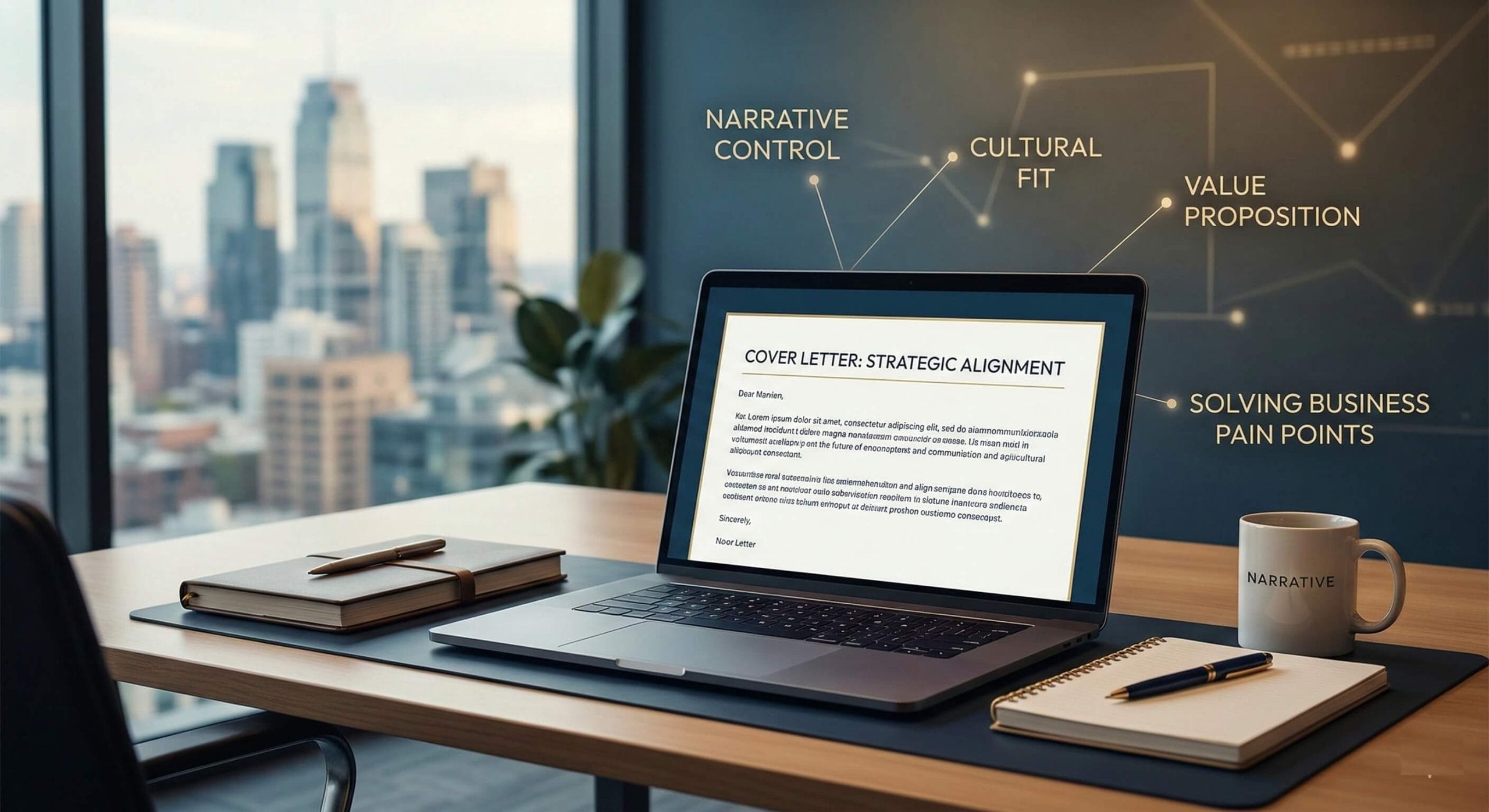
As a veteran of the talent acquisition industry, my answer is a resounding yes. However, the purpose of a cover letter has undergone a massive shift. It is no longer a polite summary; in today’s high-stakes market, it is your primary tool for narrative control and professional branding.
Beyond the Resume: Why the Narrative Matters
While your CV is a factual, chronological record of your past, it is inherently backward-looking. It tells a recruiter what you did. The true purpose of a cover letter is to tell them what you can do in their specific context.
For a senior professional, the cover letter serves three critical strategic functions:
- Connecting the Dots: If you are pivoting industries or moving from a corporate role to a consultancy, your CV might show a “gap” in direct experience. The cover letter bridges that gap, explaining how your leadership in one sector translates into value for another.
- Cultural Alignment: Talent acquisition isn’t just looking for a skill set; they are looking for a “culture add.” This is your space to demonstrate that you’ve done your homework on their mission, their current challenges, and their market position.
- Addressing the “Why Now?”: A CV rarely explains motivation. A cover letter allows you to articulate why this specific role at this specific company is the logical next step in your career arc.
The Subject Matter Expert’s Perspective: What Recruiters Really Want
From the desk of a talent acquisition lead, a stack of 500 resumes starts to look identical. We see the same action verbs and the same metric-heavy bullet points.
The purpose of a cover letter in this environment is to provide human signal in a digital noise. We are looking for:
- Voice and Personality: Can this person communicate with nuance? Are they authoritative yet collaborative?
- Contextual Proof: Instead of saying you are a “strategic thinker,” use this space to explain the problem-solving logic you used to scale a department or optimize a failing process.
- Solving Business Pain Points: We want to feel that if we put you in a room with the CEO tomorrow, you would already understand the company’s “pain points” and have a plan to address them.
Modern Best Practices for Seasoned Leaders
To ensure your cover letter meets its modern purpose, move away from the “To Whom It May Concern” templates of the past.
| Feature | Old School Approach | Modern Expert Approach |
| Opening | “I am writing to express my interest in…” | “Your recent expansion into [Market X] caught my attention because…” |
| Focus | Summarizing your history. | Solving the company’s future problems. |
| Length | Two pages of dense text. | 3–4 punchy, high-impact paragraphs. |
| Tone | Formal and detached. | Professional, warm, and conversational. |
To make this practical, let’s look at a “Before” and “After” for a Senior Operations Manager applying to a tech-focused company.
Notice how the “After” version moves away from passive listing and toward narrative control and solving business pain points.
The Scenario:
- Target Role: Head of Operations
- The Problem: The company is scaling rapidly but struggling with fragmented internal processes.
❌ Before: The “Resume Summary” (Generic & Passive)
“I am writing to apply for the Head of Operations position. I have over 15 years of experience in managing teams and improving efficiency. In my previous role at XYZ Corp, I was responsible for the daily operations and ensuring that all KPIs were met. I am a hard worker with great communication skills and I am confident that my background makes me a strong candidate for your team. I look forward to hearing from you.”
Why it fails: * It repeats the CV without adding value.
- The tone is “asking” for a job rather than “offering” a solution.
- It uses “fluff” like “hard worker” instead of contextual proof.
✅ After: The “Expert Briefing” (Strategic & Impact-Driven)
“Your recent announcement regarding the expansion into the EMEA market caught my attention, specifically the challenge of maintaining operational agility during such a high-growth phase. In my previous tenure, I orchestrated a complete departmental restructure that scaled output by 40% without increasing headcount.
My leadership philosophy centers on eliminating digital noise through process automation a value proposition I am eager to bring to your current scaling hurdles. I don’t just manage workflows; I build the strategic alignment necessary for cross-functional teams to thrive during transition. I see this role as a critical narrative thread in my career, allowing me to leverage my expertise in stakeholder management to stabilize your internal infrastructure while you focus on market capture.”
Why it works:
- Immediate Value: It opens with the company’s needs, not the candidate’s history.
- Keywords: Uses “orchestrated,” “scaled,” “value proposition,” and “strategic alignment” naturally.
- Authority: It positions the candidate as a consultant/partner rather than just another applicant.
Quick Comparison Table
| Feature | The “Before” Style | The “After” Expert Style |
| Focus | “Me, Me, Me” | “You and how I help” |
| Evidence | Vague claims | Contextual proof & metrics |
| Tone | Hopeful applicant | Senior leadership partner |
| Goal | Get an interview | Establish strategic fit |
Final Thoughts: The Competitive Edge
The purpose of a cover letter today is to act as your “elevator pitch” in written form. It’s the difference between being a candidate who meets the requirements and a candidate who feels like the inevitable choice.
When you sit down to write your next one, don’t think of it as an administrative hurdle. Think of it as your first executive briefing for your new employer. Show them not just where you’ve been, but exactly how you intend to help them win.
Create your custom Cover Letter in minutes here.