
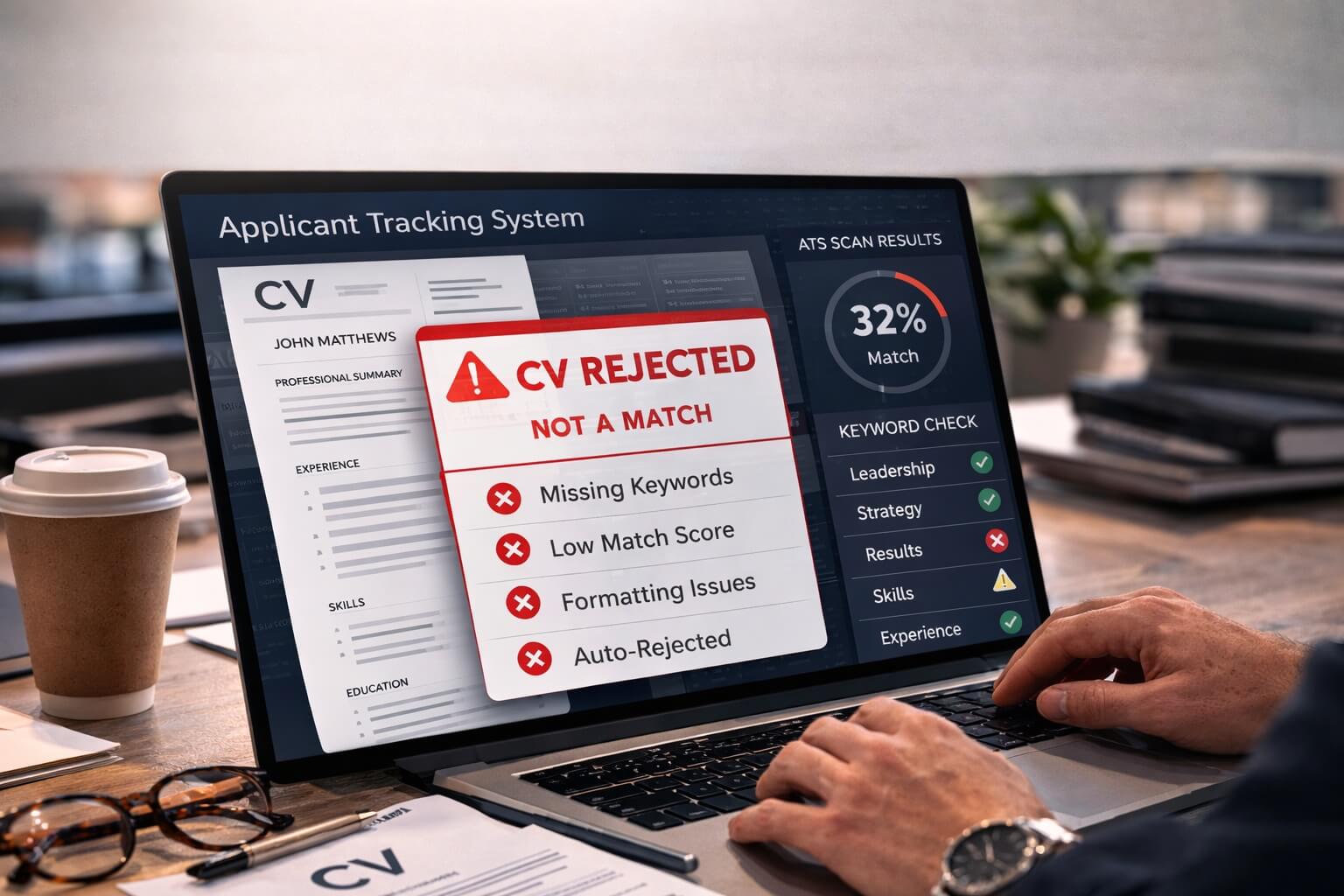
ATS can really cause a person palpitations. You spent hours perfecting your CV. You meticulously tailored your experience to the job description. You hit “Apply” and then… silence. No interview invite, no rejection email just a digital void.
In the modern job market, the problem often isn’t your lack of experience. It is that your CV never reached a human being in the first place. It was stopped by an Applicant Tracking System (ATS).
What is an ATS?
An Applicant Tracking System (ATS) is a software engine used by over 99% of Fortune 500 companies and a growing number of SMEs to manage the massive volume of job applications.
Think of it as a digital filter. Instead of a recruiter reading every individual CV, the ATS scans, “parses” (converts your document into data), and ranks candidates based on how well they match the job description. Studies suggest that up to 75% of CVs are filtered out by the ATS before a human ever sees them.
How the “Parsing” Process Works
The ATS doesn’t “read” your CV like a person does; it deconstructs it. It breaks your document down into structured data categories:
- Contact Information
- Work Experience & Job Titles
- Education & Certifications
- Hard & Soft Skills
It then compares this data against a specific “ideal candidate profile” set by the recruiter. If your CV doesn’t mirror the language, structure, and keywords of that profile, the algorithm assigns you a low score, and your application is buried.
3 “Invisible” Reasons Your CV is Being Rejected
1. Structural “Parsing” Errors
Many candidates try to stand out with creative layouts, but what looks beautiful to a human can be gibberish to a machine.
- The Danger Zone: Tables, columns, text boxes, and complex graphics often cause the parser to “scramble” your text. For example, a two-column layout might cause the ATS to read across the page, mixing two different job descriptions into one incomprehensible paragraph.
- The Fix: Stick to a clean, single-column layout.
2. Exact-Match Keyword Failure
Algorithms are often literal. If a job description lists “Project Management” as a required skill and your CV says “Managing Projects,” the ATS may not award you points for that match.
- The Nuance: You must use the exact terminology the employer uses, including industry-specific acronyms, software tools, and certifications (e.g., using “PMP” if the ad asks for it).
3. The “Unreadable” File Type
While modern systems are improving, many older ATS platforms still struggle with certain file formats.
- The Risk: Files created in Apple Pages, OpenOffice (.odt), or “flattened” PDFs (where the text is actually an image) appear completely blank to an ATS.
- The Gold Standard: A .docx (Word) file is the most universally “parseable” format, followed by a text-searchable PDF.
How to “Beat” the Algorithm
You don’t need to be a tech expert to pass the ATS filter; you just need to play by its rules:
- Mirror the Job Description: Identify the 5 most important skills in the ad and ensure they appear verbatim in your CV.
- Standardize Your Headers: Use “Work Experience” instead of “Professional Timeline” and “Education” instead of “Academic Background.”
- Avoid Decorative Elements: Remove icons, skill bars, and photos. They add zero value to an ATS and only increase the risk of a parsing error.
- Tailor, Don’t Spray: A generic CV is the easiest target for an ATS rejection. Every application should be a 90% match for that specific role.
Let Smart CV Builder Do the Hard Work
Optimizing for an algorithm shouldn’t feel like a full-time job. Smart CV Builder was engineered specifically to solve the “ATS Black Hole” problem.
Our platform uses parser-vetted templates that are guaranteed to be readable by every major ATS on the market. We don’t just help you write; we help you rank.
- Keyword Suggestions: Get real-time prompts for the skills recruiters are looking for.
- Clean Exporting: Your CV is exported in the exact format required for high-speed parsing.
- Compatibility Check: Ensure your contact details and job titles are in the right place for the machine to find them.
Stop losing to the algorithm. Build your ATS-ready CV with Smart CV Builder today.