Solid interview preparation is what separates candidates who ramble from candidates who get offers. Most interviews are decided in the first ten minutes, and those ten minutes are shaped by the work done in the days before. This guide walks through nine practical steps that take you from “invitation received” to “offer on the table”, starting with the document that got you the interview in the first place: your CV.
Table of Contents
- Why Interview Preparation Starts With Your CV
- Step 1: Re-Read Your CV Line by Line
- Step 2: Research the Company and the Interviewer
- Step 3: Decode the Job Description for Likely Questions
- Step 4: Build STAR Answers for Competency Questions
- Step 5: Practise the Awkward Questions Out Loud
- Step 6: Prepare Intelligent Questions to Ask Them
- Step 7: Sort the Logistics the Day Before
- Step 8: Get Your Documents and References Ready
- Step 9: Follow Up Within 24 Hours
Why Interview Preparation Starts With Your CV
Interviewers build most of their questions directly from your CV. Every bullet point, date and claim on that document is a potential question, which means your CV is effectively the exam paper you wrote for yourself.
Before anything else, make sure the version you sent is the version you remember. If you tailored it for this role (and you should have), reread that exact file. Being caught out by your own CV is one of the fastest ways to lose an interviewer’s confidence, and it is entirely avoidable.
Step 1: Re-Read Your CV Line by Line
Go through the CV you submitted and, for each bullet point, prepare a short story that proves it. If it says you “reduced processing time by 30%”, be ready to explain how, with what tools, and what obstacles you hit along the way.
Strong, quantified bullet points make this much easier because the evidence is already built in. If yours are vague, see our guide on how to write CV bullet points that prove your value before your next application.
Step 2: Research the Company and the Interviewer
Spend at least an hour on the company website, recent news coverage and their LinkedIn page. Note their products, competitors, recent wins and any challenges in their sector. You are looking for two or three specific facts you can weave into your answers naturally.
If you know who is interviewing you, look them up. Understanding whether you are meeting a hands-on manager or an HR generalist changes how technical your answers should be.
Step 3: Decode the Job Description for Likely Questions
The job description is a question bank in disguise. Every “essential” requirement will almost certainly generate at least one question, so list each requirement and match it to a concrete example from your experience.
Where you lack direct experience, prepare a transferable equivalent. Candidates who acknowledge a gap and immediately bridge it with a related example come across as self-aware rather than underqualified.
Step 4: Build STAR Answers for Competency Questions
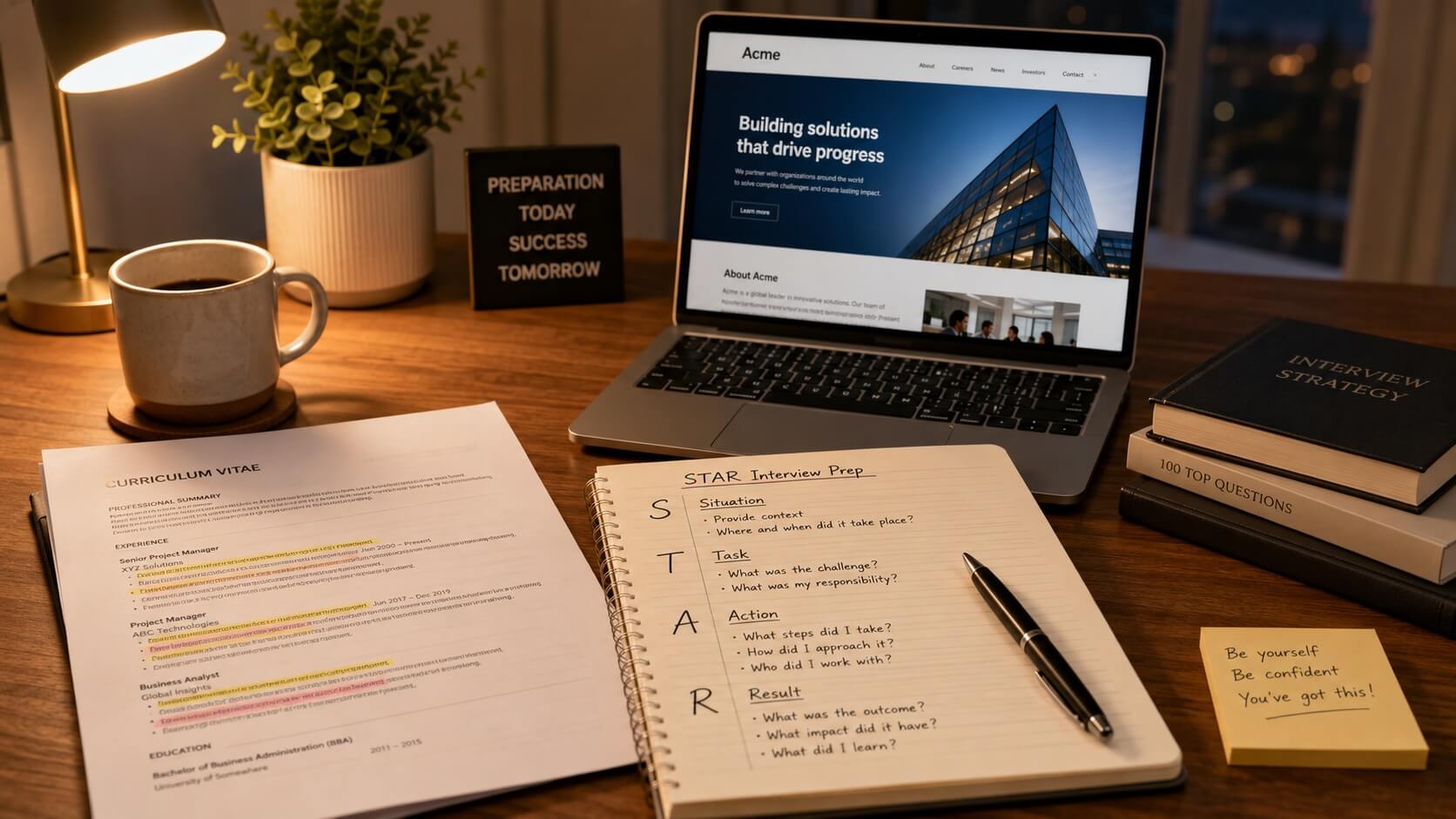
Good interview preparation means having six to eight STAR stories (Situation, Task, Action, Result) ready to deploy. Cover the classics: a conflict you resolved, a deadline you rescued, a mistake you fixed, a process you improved, and a time you led without authority.
“When our biggest client threatened to leave (Situation), my manager asked me to rebuild the relationship (Task). I set up weekly check-ins and fixed their three biggest complaints within a month (Action). They renewed for two years at a 15% higher contract value (Result).”
Keep each story under two minutes. The result is the part interviewers remember, so never trail off before you reach it.
Step 5: Practise the Awkward Questions Out Loud
“Why did you leave your last role?”, “What is your biggest weakness?” and “Why is there a gap in your employment?” are uncomfortable precisely because they are predictable. Draft honest, concise answers and say them out loud until they sound natural rather than rehearsed.
If gaps are a worry, our guide to explaining employment gaps on your CV covers framing that works in interviews too. The rule is the same: brief, honest, forward-looking.
Step 6: Prepare Intelligent Questions to Ask Them
“Do you have any questions for us?” is not a formality; it is a scored part of the interview. Prepare four or five questions in case some get answered along the way.
Ask about success measures for the first six months, the team’s biggest current challenge, or how the role has evolved. Avoid questions about holidays and perks until an offer is on the table.
Step 7: Sort the Logistics the Day Before
For in-person interviews, plan the route, check for rail disruptions and aim to arrive fifteen minutes early. For video interviews, test your camera, microphone, lighting and connection the day before, not ten minutes before.
Video calls bring their own pitfalls, from eye contact to AI screening tools. Our guide to video interviews and AI screeners covers how to perform well on camera.
Step 8: Get Your Documents and References Ready
Bring printed copies of your CV, any requested certificates and a notepad. Have your references warmed up: contact them in advance, tell them about the role, and confirm they are happy to respond quickly.
The National Careers Service interview advice also recommends preparing evidence of your right to work in the UK, as many employers now ask for this at interview stage.
Step 9: Follow Up Within 24 Hours
Send a short thank-you email within a day. Reference one specific moment from the conversation, restate your interest and offer to provide anything further. Two or three sentences is plenty.
If you hear nothing after the stated decision date, one polite chase is professional; three is not. While you wait, keep applying elsewhere. Momentum is the best cure for post-interview nerves, and consistent interview preparation gets faster with every role you pursue.
One final point: none of this matters if your CV is not generating interviews in the first place. If invitations are thin on the ground, run through the fixes in our guide on why your CV is not getting interviews, then come back to this checklist once the invitations arrive. Treat interview preparation as a repeatable system, not a one-off panic, and each interview will feel easier than the last.
Walk Into Your Next Interview With a CV You Can Defend
Smart CV Builder helps you create a tailored, ATS-friendly CV with quantified achievements you can talk about with confidence.