
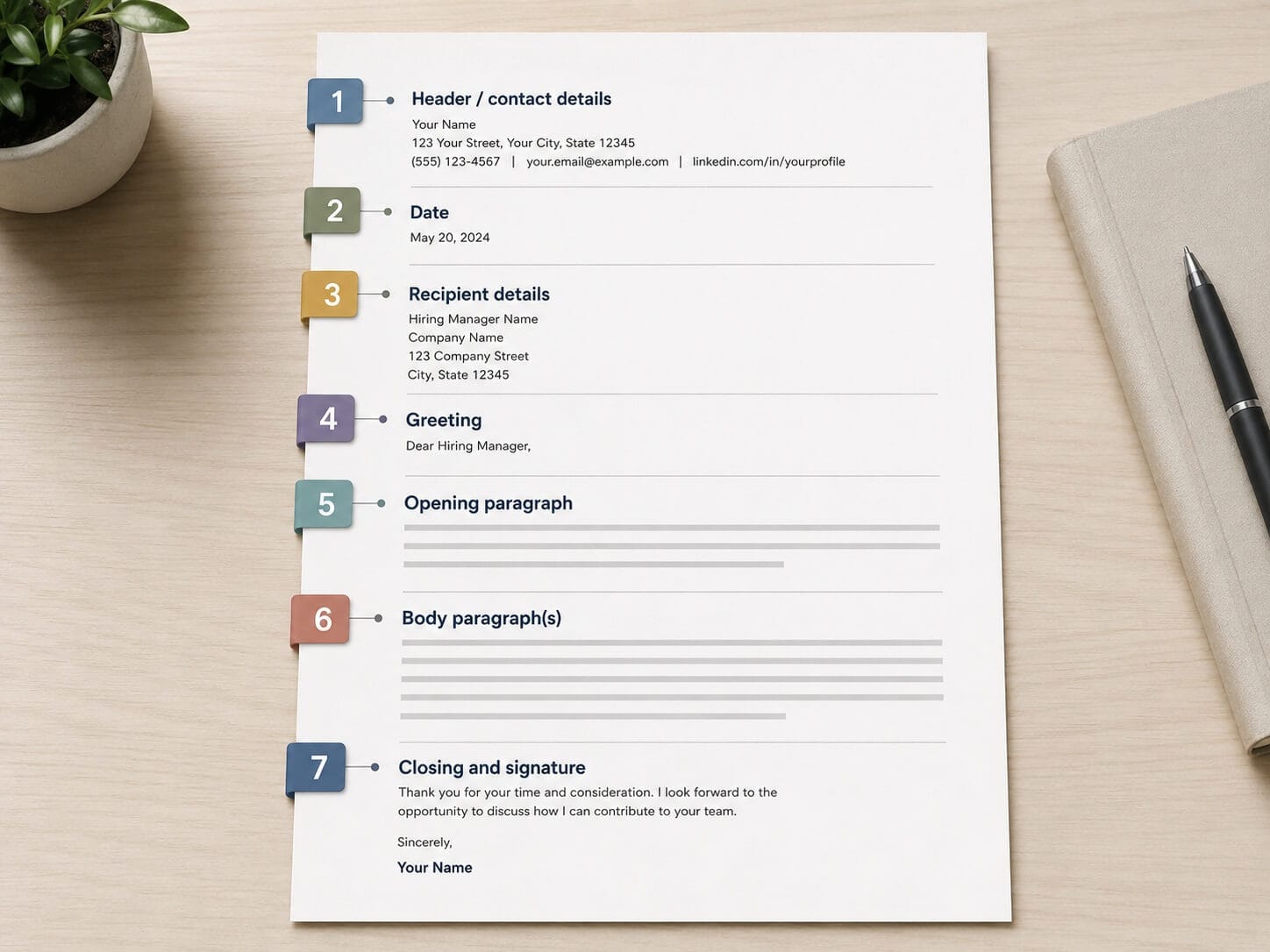
Most rejected cover letters are not badly written. They are badly organised. A hiring manager scanning forty applications before lunch needs to find the relevant information fast, and a clear cover letter structure is what makes that possible. Get the order right and your letter does the persuading for you.
The cover letter structure below works for almost every UK application, from graduate schemes to senior appointments. Each part has one job. Once you know what that job is, writing the letter takes twenty minutes rather than a whole evening.
What this guide covers
- Part 1: Contact details and a proper greeting
- Part 2: An opening line that names the role
- Part 3: Why this employer, specifically
- Part 4: Two pieces of hard evidence
- Part 5: Handling the obvious objection
- Part 6: A closing paragraph with a clear next step
- Part 7: Formatting the finished page
- Cover letter structure mistakes that cost interviews
Part 1: Contact details and a proper greeting
Put your name, phone number, email address and town at the top. A full postal address is no longer expected, and city plus county is enough for a recruiter checking whether you can reach the office.
Address the letter to a named person wherever possible. The hiring manager is often listed on the job advert, the company website or LinkedIn. “Dear Ms Okafor” signals effort in a way that “To whom it may concern” never will. If the name genuinely cannot be found, “Dear Hiring Manager” is the safest fallback.
Part 2: An opening line that names the role
The first sentence exists to orient the reader. State the exact job title and where you saw it advertised, because larger organisations run several vacancies at once and yours needs routing correctly.
Then earn the next paragraph. One specific hook, delivered immediately, beats any amount of throat-clearing about how delighted you are to apply.
Part 3: Why this employer, specifically
This is the paragraph most applicants skip, and it is the one that separates a tailored letter from a template. Name something real about the organisation: a recent contract win, a service they have launched, a value that matches how you already work.
Two sentences will do. The point is to prove you have read beyond the job title, not to flatter. Vague praise about a “fantastic reputation” reads as filler and adds nothing to your case.
Part 4: Two pieces of hard evidence
Choose the two requirements that matter most in the advert and prove you meet them. Usually these sit in the first three bullet points of the person specification, because job adverts tend to be written in priority order.
Each proof needs a result attached. “Managed the social media accounts” is a duty; “grew the mailing list from 400 to 2,300 subscribers in eight months” is evidence. The same discipline applies to your CV, which is why our guide on writing CV bullet points that quantify achievements is worth reading alongside this one.
Do not repeat your CV line by line. The letter should connect the dots that the CV leaves the reader to join themselves.
Part 5: Handling the obvious objection
If something in your application raises a question, answer it here in one or two calm sentences. A career break, a relocation, a sector change or a shorter stint than usual all sit comfortably in this slot.
Raising it yourself removes its power. Left unexplained, a reader fills the silence with their own assumptions, which are rarely generous. Our article on explaining employment gaps covers the wording in more depth.
Skip this part entirely when nothing needs explaining. Never invent a weakness for the sake of the format.
Part 6: A closing paragraph with a clear next step
Three lines is plenty. Restate your interest, mention your availability for interview and thank the reader for their time. Confidence works better than pleading, so “I would welcome the chance to discuss the role” lands more comfortably than “I hope you will consider me”.
Sign off with “Yours sincerely” when you have used a name, and “Yours faithfully” when you have not. British recruiters still notice the difference, and the National Careers Service cover letter guidance sets out the same convention.
Part 7: Formatting the finished page
One page, always. A tight cover letter structure runs to 250 or 400 words across three or four paragraphs, with a blank line between each so the page breathes.
Match the font to your CV so the two documents look like a set. Send as a PDF unless the advert asks for a Word file, and name it clearly: Surname-CoverLetter-JobTitle.pdf. Applicant tracking systems and recruiters both cope better with sensible file names.
Cover letter structure mistakes that cost interviews
The most common error is a letter that opens with a life story rather than a claim. Recruiters read the first two lines and decide whether to continue, so front-load your strongest point.
Reusing one generic letter across every application is the second. Changing only the company name leaves the rest of the letter saying nothing that a hundred other applicants could not also say.
The third is length. Anything spilling onto a second page suggests you cannot prioritise, and a weak letter attached to a strong CV drags the whole application down. If your applications are going quiet, it is worth checking both documents against our most common CV mistakes guide and running through the final checklist before applying.
A reliable cover letter structure removes the hardest part of writing, which is deciding what goes where. With the order fixed, you only need to supply the evidence, and the evidence is the part employers actually want.
Build a CV your cover letter can stand behind
Smart CV Builder helps you create a tailored, ATS-ready CV in minutes, so every application you send is backed by a document that matches your letter.